
Mackinac Projected and Actual Dates
A projected date is a calculation based on the sentence and facts known at that time. It may mark parole eligibility, a county sentence endpoint, or a maximum discharge point. The actual release date is when the custodian finishes the physical release or transfers the person to another authority. A court order can authorize release before jail staff have checked warrants, confirmed detainers, returned property, and completed checkout.
For a person awaiting trial at Mackinac County Jail, there often is no sentence endpoint to calculate. Bond may be posted, conditions may change, a case may be dismissed, or the court may order continued detention. The jail can report current custody and an actual completed departure. The 92nd District Court or 11th Circuit Court record explains the legal basis. Neither a future hearing date nor a signed order is the same as a completed jail release.
Transfers require special care. A Mackinac jail departure to MDOC, another county, USMS, or ICE ends local custody but does not put the person in the community. Follow the receiving system before describing the event as release.
Find a Mackinac Release Date
Choose the search path by custody type. The Mackinac County Jail does not publish a verified online projected-date tool. For a local sentence, call the jail at (906) 643-7325, then obtain the judgment and the jail's existing time computation. For a Michigan prison sentence, use MDOC OTIS. It covers people under MDOC jurisdiction, not every person booked into the county jail.
- Identify the current custodian and whether the case is pretrial, a county jail sentence, or an MDOC prison sentence.
- For MDOC custody, search OTIS by MDOC number when possible and match the person, offense, and sentencing county.
- Read status, location, Earliest Release Date, Maximum Discharge Date, and sentence details together.
- For Mackinac County jail time, obtain the judgment from the proper court and ask the jail for its existing calculation.
- Check for consecutive terms, other cases, warrants, probation detainers, federal or immigration holds, and amended orders.
- Recheck near the expected event and preserve the dated official record used for confirmation.
The Mackinac County released inmate search explains how to follow a person after the release or transfer has already occurred.
Mackinac OTIS Release Date Fields
OTIS is the main public state source when a Mackinac County case led to an MDOC sentence. Search by MDOC number for the cleanest match. A name search should be checked against aliases, physical descriptors, the offense, court, county, and location. Open the full record rather than relying on a result row. OTIS warns that its public display can change and is not the official record.
| OTIS field | What it means | Limit |
|---|---|---|
| Current Status | Prisoner, parolee, probationer, discharged, or another published state status | Status belongs to MDOC jurisdiction, not county jail custody |
| Earliest Release Date | Earliest parole consideration or Parole Board jurisdiction date in applicable cases | Not a promised gate date |
| Maximum Discharge Date | Outer MDOC sentence or discharge point as currently calculated | Can change with lawful sentence events |
| Location or office | Institution or supervising field office | A parole office means community supervision, not full discharge |
| Sentence and offense | Terms needed to identify the correct case and calculation | Read with the judgment, offense date, and consecutive structure |
The successful manifest capture from the official OTIS search shows the state form used to reach those fields.
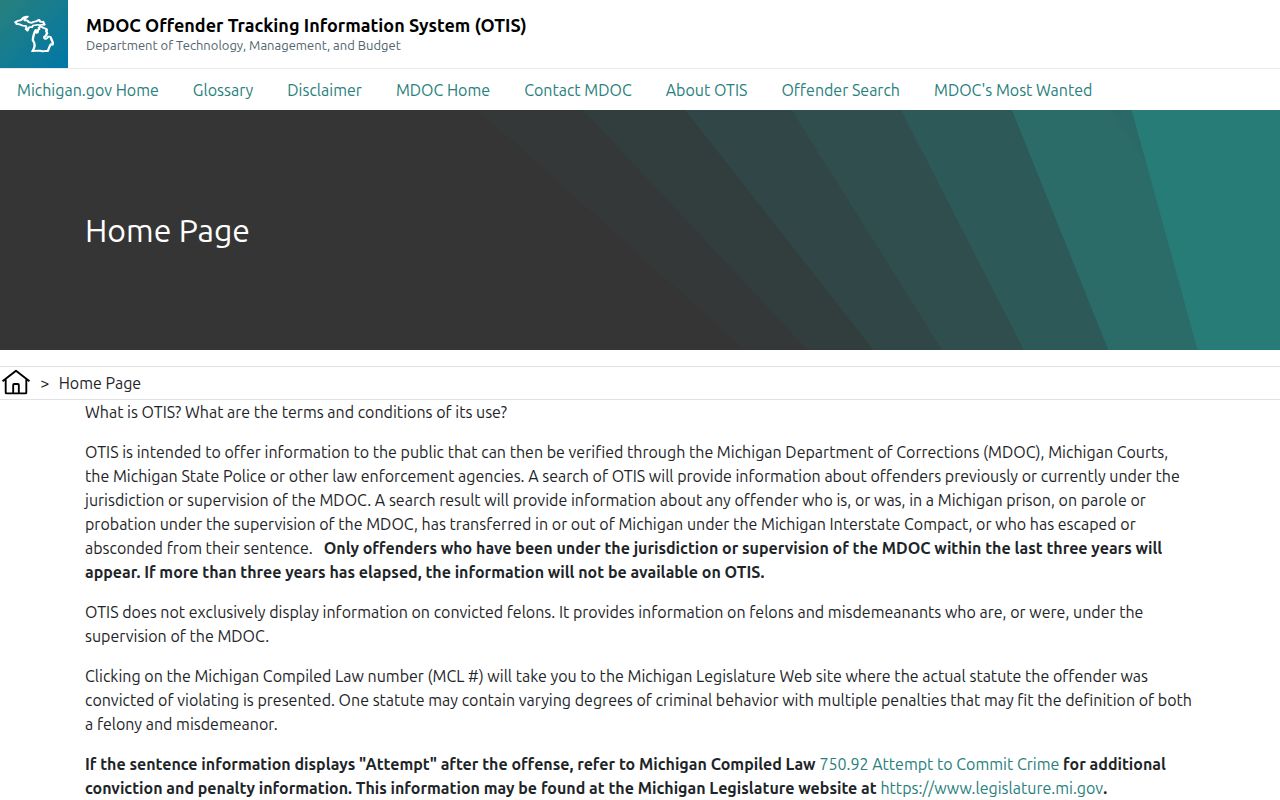
The form is statewide. A Mackinac County bond release or county-jail-only sentence may never appear because OTIS is not a local booking archive.
Note: The MDOC number is the safest OTIS identifier when names or aliases could point to more than one person.
Mackinac Earliest Release Date
The phrase “Earliest Release Date” can sound more definite than it is. MDOC explains that, in applicable indeterminate sentences, this is the point when the Parole Board first has jurisdiction to consider release. Eligibility permits review. It does not require the Board to grant parole, and it does not state the hour a person will leave a prison.
Michigan's indeterminate structure commonly includes a minimum and maximum term. The judicial minimum is central to parole eligibility, while the maximum frames the outer sentence endpoint under the law and current calculation. A parolee has left prison under conditions but remains within MDOC jurisdiction. Full discharge is a later legal event unless the sentence structure produces another result.
For parole consideration, the Board can grant, deny, defer, continue, or reconsider within applicable law and policy. A favorable action can still be followed by placement work, conditions, detainer resolution, processing, or lawful rescission. That is why the OTIS eligibility field, Board action, and actual custody event must remain separate.
Mackinac Truth-in-Sentencing Dates
Michigan truth in sentencing is not a universal “85 percent” formula. MDOC materials state that covered assaultive offenses committed on or after December 15, 1998, and other covered offenses committed on or after December 15, 2000, do not earn good-time or disciplinary credits against the judicial minimum. The covered minimum must be served in confinement before parole eligibility. Older offenses may fall under earlier credit rules, and special sentence types can differ.
MCL 791.234 is a key parole-jurisdiction statute. The official statute capture shows why the individual sentence and offense date matter.
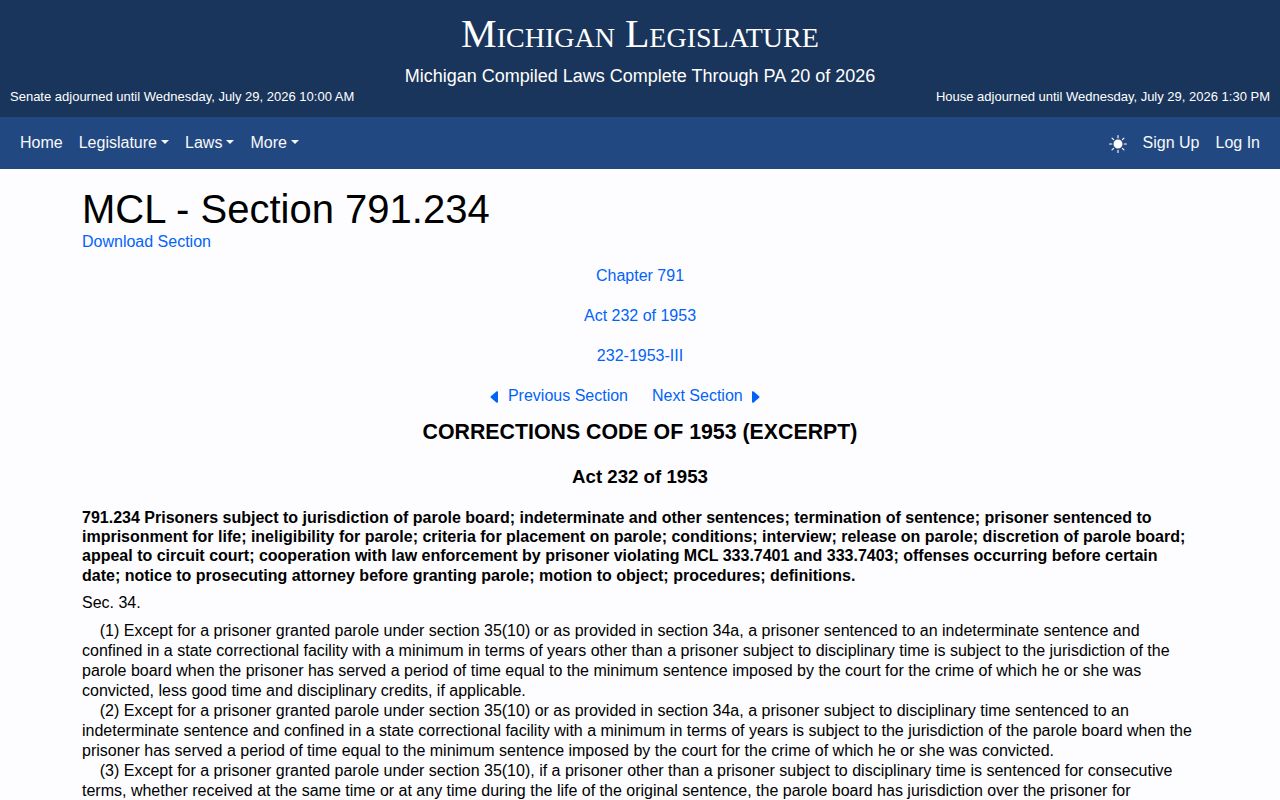
The statute contains distinctions that cannot be replaced by multiplying a sentence by a single percentage. Use OTIS, the judgment, and MDOC's existing time-computation record.
Program participation or policy proposals also should not be presented as a guaranteed cut to every minimum. Only enacted law and the individual MDOC calculation control. If the computation is disputed, request the existing state record or consult the sentencing court and qualified counsel.
Mackinac Jail Release Computation
OTIS does not calculate an ordinary Mackinac County jail sentence. The starting documents are the judgment of sentence and the jail's own computation. Key facts include the actual commitment date, credit for time already served, concurrent or consecutive terms, authorized county-jail good time, any forfeiture or restoration, later court orders, and holds from another case or authority.
- Credit for time served
- Days credited toward the sentence under the judgment and applicable law.
- Concurrent terms
- Terms that run at the same time, as legally ordered.
- Consecutive terms
- Terms that run one after another and extend the total custody span.
- Detainer
- A notice that another authority may claim custody even when the current term ends.
MCL 51.281 supplies Michigan's county-jail good-time framework and ties it to faithful observance of jail rules. Forfeiture and restoration mean the Sheriff’s actual record matters. MCL 769.11b governs credit for time served in covered circumstances. Neither statute turns a sentence shown on the web into a guaranteed release date.
Ask the jail for the existing calculation rather than asking staff to create a new legal opinion. Compare that record with the judgment and any amended order. A current jail confirmation remains necessary near the expected date because another hold can change the destination without changing the original sentence length.
Mackinac Weekend Release Timing
Weekend and holiday timing is a separate local computation issue. MCL 801.257 authorizes specified early timing when a fixed expiration falls on a weekend or legal holiday. Its wording does not support a blanket promise that every Sunday endpoint becomes a Friday release.
No official Mackinac County weekend-release policy or routine gate time was verified. The jail may need to resolve credits, property, paperwork, transportation, or another hold. Call (906) 643-7325 for the operational answer tied to the named booking, and request the calculation when a durable record is needed.
Note: A holiday calendar, estimated sentence endpoint, and completed release timestamp are three different records and should not be merged.
Why Mackinac Release Dates Move
A future date can change without a public-system error. Compare each update with a dated source and identify which authority made it. The cause may sit in the court file, jail calculation, Parole Board record, or a second custodian's hold.
| Change | Possible effect | Record to check |
|---|---|---|
| Amended or vacated sentence | Changes the legal term or authority for custody | Mackinac court order and register of actions |
| Credit recalculation | Moves a county or state computation | Jail or MDOC time-computation record |
| Good-time forfeiture or restoration | Changes an applicable county-jail endpoint | Sheriff computation under the applicable rule |
| Parole denial or deferral | Prevents departure at the eligibility point | Parole Board action and OTIS |
| New detainer or warrant | May cause continued custody or transfer | Holding and receiving authorities |
| Consecutive sentence | Adds another term after the first | Judgment and sentence records |
| Data-entry lag | Leaves a public field behind the agency record | Dated confirmation from the custodian |
Confirm Mackinac Actual Release
Near a pending event, recheck the source that owns the calculation. MDOC status and date fields cover state prisoners. Mackinac County Jail and the sentencing court cover a local sentence. MI-VINE can provide a supported custody-change alert when registration precedes the event, but it is not a permanent release record and updates can lag.
The Mackinac County VINELink check explains the county and state notification paths. For durable proof, keep the actual jail release record, MDOC parole or discharge document, and relevant court order. Record the date accessed and exact status wording. That evidence shows whether the event was community release, parole, discharge, or transfer rather than only that a predicted day arrived.
A completed verification should answer three points. First, name the custodian whose control ended. Second, state whether the destination was the community, conditional supervision, or another agency. Third, cite the actual timestamp or effective date from that custodian's record. This structure prevents a court authorization time from being reported as the jail checkout time. It also prevents an MDOC parole-eligibility date from being repeated as a guaranteed prison departure.
If public sources disagree, compare when each was updated and request the existing source record. The court judgment controls the sentence it imposed. The jail documents local physical processing. MDOC calculates its prison term and supervision fields. MI-VINE relays a participating agency event. None of those offices should be asked to certify another office's data.
Note: A full confirmation names the custodian, destination, and actual effective date instead of repeating a projected date alone.